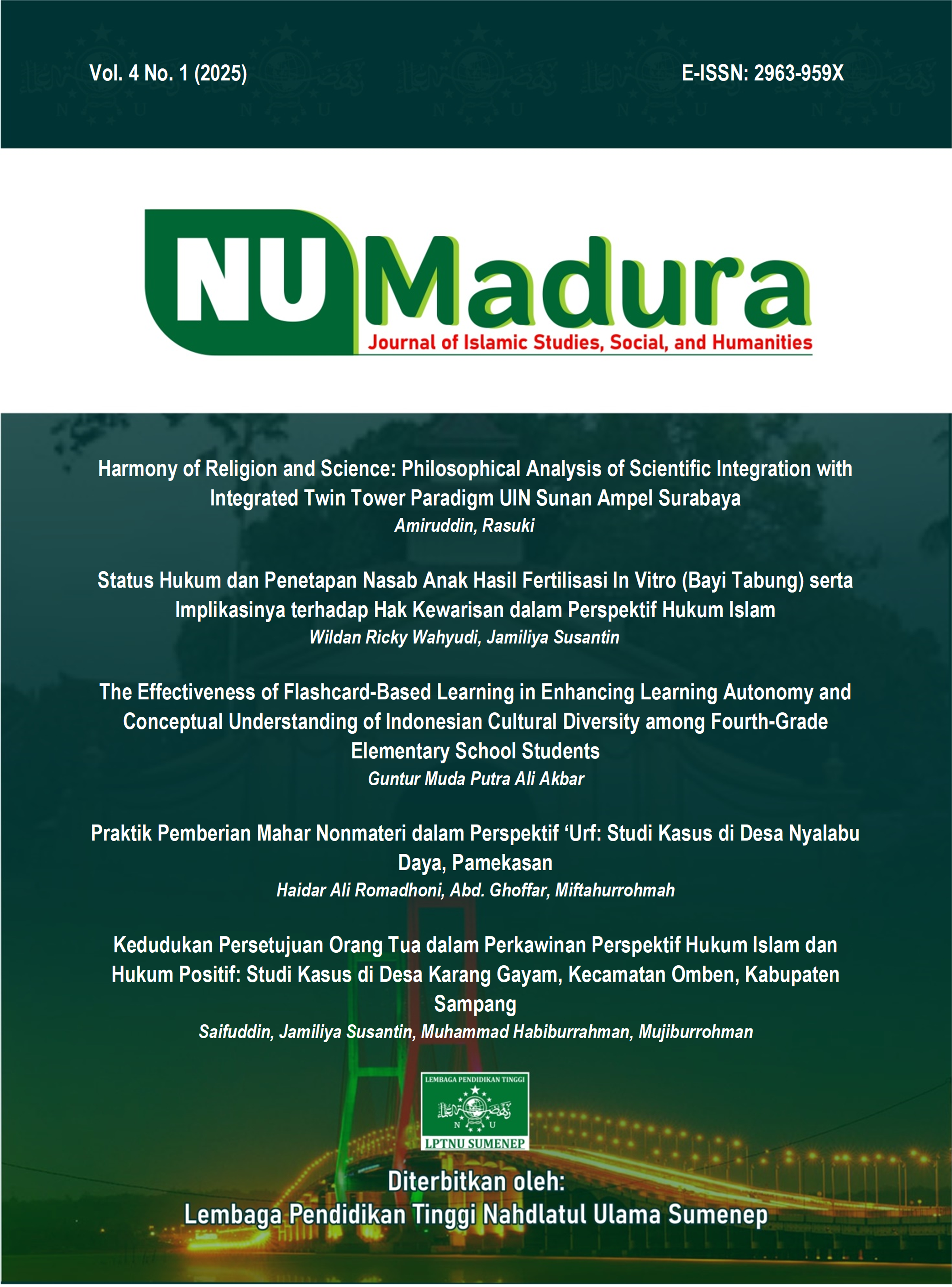
Kedudukan Persetujuan Orang Tua dalam Perkawinan Perspektif Hukum Islam dan Hukum Positif: Studi Kasus di Desa Karang Gayam, Kecamatan Omben, Kabupaten Sampang
DOI:
https://doi.org/10.58790/mjp7ee17Keywords:
Parental Blessing; Marriage; Islamic Law; Positive Law; Birr al-Walidayn; Madurese SocietyAbstract
This study examines the position of parental blessing in marriage from the perspectives of Islamic law and positive law, focusing on the social practices of the community in Karang Gayam Village, Omben District, Sampang Regency. It aims to describe how parental blessing is understood and practiced in marriage and to analyze its legal position within the two legal frameworks. This research employs empirical legal research with a qualitative approach using phenomenological methods. Data were collected through interviews, observation, and documentation, involving eight informants selected through purposive sampling: two married men, two married women, two community leaders, and two local community members. The findings indicate that parental blessing holds significant social and cultural importance. It is perceived not merely as parental approval but also as an expression of respect, religious devotion, and a source of blessing and harmony in family life. Marriages conducted without parental blessing may lead to family conflict, strained relationships, negative social perceptions, and reduced family support. From the perspective of Islamic law, parental blessing is associated with the moral and religious obligation of birr al-walidayn, the principle of maslahah mursalah, and the institution of the marriage guardian (wali). Meanwhile, under Indonesian positive law, parental blessing generally functions as an ethical and familial value rather than an absolute legal requirement for adult prospective spouses. This study highlights the importance of balancing individual marital rights with parental respect and social harmony
References
Creswell, J. W., & Poth, C. N. (2018). Qualitative inquiry and research design: Choosing among five approaches (4th ed.). SAGE Publications.
Fauzi, A. (2021). Perkawinan tanpa restu orang tua dalam perspektif hukum Islam dan dampaknya terhadap keharmonisan rumah tangga [Skripsi, UIN (nama universitas belum dicantumkan)].
Ghazaly, A. R. (2010). Fiqh munakahat. Kencana.
Hasanah, N. (2019). Analisis yuridis perkawinan tanpa izin orang tua menurut Undang-Undang Perkawinan [Skripsi, IAIN (nama institusi belum dicantumkan)].
Instruksi Presiden Republik Indonesia Nomor 1 Tahun 1991 tentang Kompilasi Hukum Islam.
Kementerian Agama Republik Indonesia. (n.d.). Al-Qur’an dan terjemahannya. Lajnah Pentashihan Mushaf Al-Qur’an, Kementerian Agama Republik Indonesia.
Miles, M. B., Huberman, A. M., & Saldaña, J. (2014). Qualitative data analysis: A methods sourcebook (3rd ed.). SAGE Publications.
Republik Indonesia. (1974). Undang-Undang Nomor 1 Tahun 1974 tentang Perkawinan.
Republik Indonesia. (2019). Undang-Undang Nomor 16 Tahun 2019 tentang Perubahan atas Undang-Undang Nomor 1 Tahun 1974 tentang Perkawinan.
Fakhria, Sheila. “Cerai Gugat Dan Implikasinya Terhadap Pemenuhan Hak-Hak Finansial Perempuan.” Legitima Journal: Journal Of Law And Social Justice, Vol. 3, No. 1, 2019. DOI: https://doi.org/10.33367/legitima.v1i1.648
Hadjon, Philipus M. Perlindungan Hukum Bagi Rakyat Indonesia. Surabaya: Bina Ilmu, 1987.
Ibrahim, A. R., Dan Nasrullah. “Eksistensi Hak Ex Officio Hakim Dan Batas Penerapannya Dalam Perkara Perceraian.” Samarah: Jurnal Hukum Keluarga Dan Hukum Islam, Vol. 6, No. 1, 2022. DOI: https://doi.org/10.22373/sjhk.v1i2.2378
Rijali, A. (2018). Analisis data kualitatif. Alhadharah: Jurnal Ilmu Dakwah, 17(33), 81–95. https://doi.org/10.18592/alhadharah.v17i33.2374 DOI: https://doi.org/10.18592/alhadharah.v17i33.2374
Siti Aisyah. (2020). Peran wali dalam perkawinan perspektif hukum Islam [Skripsi, UIN (nama universitas belum dicantumkan)].
Syarifuddin, A. (2006). Hukum perkawinan Islam di Indonesia: Antara fiqh munakahat dan Undang-Undang Perkawinan. Kencana.
Syarifuddin, A. (2008). Ushul fiqh (Jilid 2). Kencana.
Downloads
Published
Issue
Section
License
Copyright (c) 2025 Saifuddin, Jamiliya Susantin, Muhammad Habiburrahman, Mujiburrohman (Author)

This work is licensed under a Creative Commons Attribution-NonCommercial-NoDerivatives 4.0 International License.